The technology exists. The buildings do not.
Limewise was established to invent, develop and deploy the technology the United Kingdom needs to deliver high-density, high-quality housing, and to bring construction into parity with the industries already transformed by computation. The retrofit work published on this site is the first proving ground for that programme, not its conclusion.
The United Kingdom is short by roughly one and a half million homes against its own ten-year delivery target. The shortfall is consistently described as a planning problem, a financing problem, or a labour problem. It is in fact a technology problem, and the construction industry is the only major sector of the British economy that has not yet been re-tooled to address it.
Architecture, structural engineering, services design, quantity surveying, compliance and procurement are still carried out, in 2026, with substantively the same workflows that obtained in 1995. Drawings are produced one at a time. Specifications are written one at a time. Costs are estimated one at a time. The cost of bringing a single home into existence — whether new build or deep retrofit — is dominated not by materials or labour but by the human time required to design, specify, cost, consent and supervise it.
That cost is the binding constraint on national housing supply. It is also the cost that contemporary computation, properly applied, can collapse.
The tools that have re-shaped finance, logistics, medicine and aerospace over the past decade are available to construction. Large-scale machine inference can read drawings, assess planning policy, generate compliant specifications, cost a scheme against current market rates, and identify the procurement route most likely to deliver it. Parametric and generative geometry can produce buildable design variants at a rate no human studio can match. Sensor networks can verify in-use performance against design intent. None of this is speculative.
What is missing is the application. The construction sector procures technology the way it procures windows — as discrete products from external vendors — rather than as an integrated capability built inside the operator. The result is that the most computationally sophisticated industries on earth deliver buildings using software workflows that would have been recognisable to a practice in the late twentieth century.
Limewise treats this gap as the central commercial opportunity of the decade. The practice's working assumption is that an operator that develops the technology in-house, deploys it on its own schemes, and refines it through the feedback loop of actually-built outcomes will hold a structural cost and quality advantage over any operator that does not.
The United Kingdom cannot resolve its housing shortfall through dispersed low-density development. The land is not available, the infrastructure cost is prohibitive, the embodied carbon is indefensible, and the resulting communities perform poorly on every measure of long-term liveability. The country's existing high-quality urban fabric, from Georgian Bath to Victorian Glasgow, is denser than anything currently being granted consent. The historical evidence that dense, well-designed living is preferred by occupants when it is delivered to standard is overwhelming.
Limewise designs and develops for density first. That means infill on under-used urban plots; conversion and intensification of existing residential and commercial buildings; thoughtful additional storeys where structure and policy permit; and small-site allocation under the December 2024 National Planning Policy Framework reforms. Each scheme is specified against the same fabric, ventilation and whole-life carbon standards published under Approach; each is required to produce homes that are quieter, warmer, better lit and more durable than the volume housebuilder benchmark.
The objective is not density for its own sake. The objective is to demonstrate that a unit of well-designed, well-insulated, well-ventilated urban housing — produced through a technology-augmented workflow — can be delivered at a cost and a quality that current industry practice cannot reach. That is the only route by which the British housing market is solved at scale.
How the maths actually works.
The technical solutions that would let a UK home generate much of its own energy, recover its own heat, and approach a net-zero operational footprint exist today. They are not used at scale because, applied to a single household, they are economically untenable. A meaningful self-sustaining specification — solar generation, battery storage, mechanical ventilation with heat recovery, a heat pump, fabric upgrades to airtightness — can comfortably approach fifty thousand pounds per home before any allowance for design fees, planning, or disruption. No working household can be asked to absorb that as a single line on a mortgage. This is the point at which most retrofit and most net-zero rhetoric quietly fails.
Density changes the arithmetic. The same fifty thousand pounds of technology, distributed across ten dwellings, becomes five thousand pounds per dwelling — and the per-dwelling benefit is, in many cases, larger than if a single household had paid the full sum alone. Shared heat networks operate at higher round-trip efficiencies than individual heat pumps. Aggregated rooftop solar exceeds the panel area available on any one home. Battery storage at scale unlocks demand-shifting tariffs that single-meter homes cannot access. The technology is not divided by the number of units; the cost is divided, and the benefit often multiplies.
This is the mechanism by which the cost-of-living crisis, the housing shortfall and the environmental imperative cease to be three competing priorities and become one coherent answer. Density delivers more homes. Self-sustaining specification delivers lower bills and lower lifetime carbon. The combination of the two — and only the combination — delivers either at a price working households can absorb. A single owner-occupier should not be expected to pay fifty thousand pounds for solar and storage on a detached house. Ten households, each paying five thousand pounds toward a shared system, can reach the same outcome at one-tenth of the personal cost and several times the technical sophistication.
Limewise designs to this thesis. Every scheme is assessed both for the homes it will produce and for the shared infrastructure those homes will operate through — energy generation, storage, heating, ventilation, water, monitoring — specified at the cluster level rather than the dwelling level. The cost of doing self-sustaining housing properly is not affordable on a single dwelling. On a thoughtfully-designed cluster of dwellings, it is the only thing that is.
The order in which we intend to do this.
Build the practice on retrofit
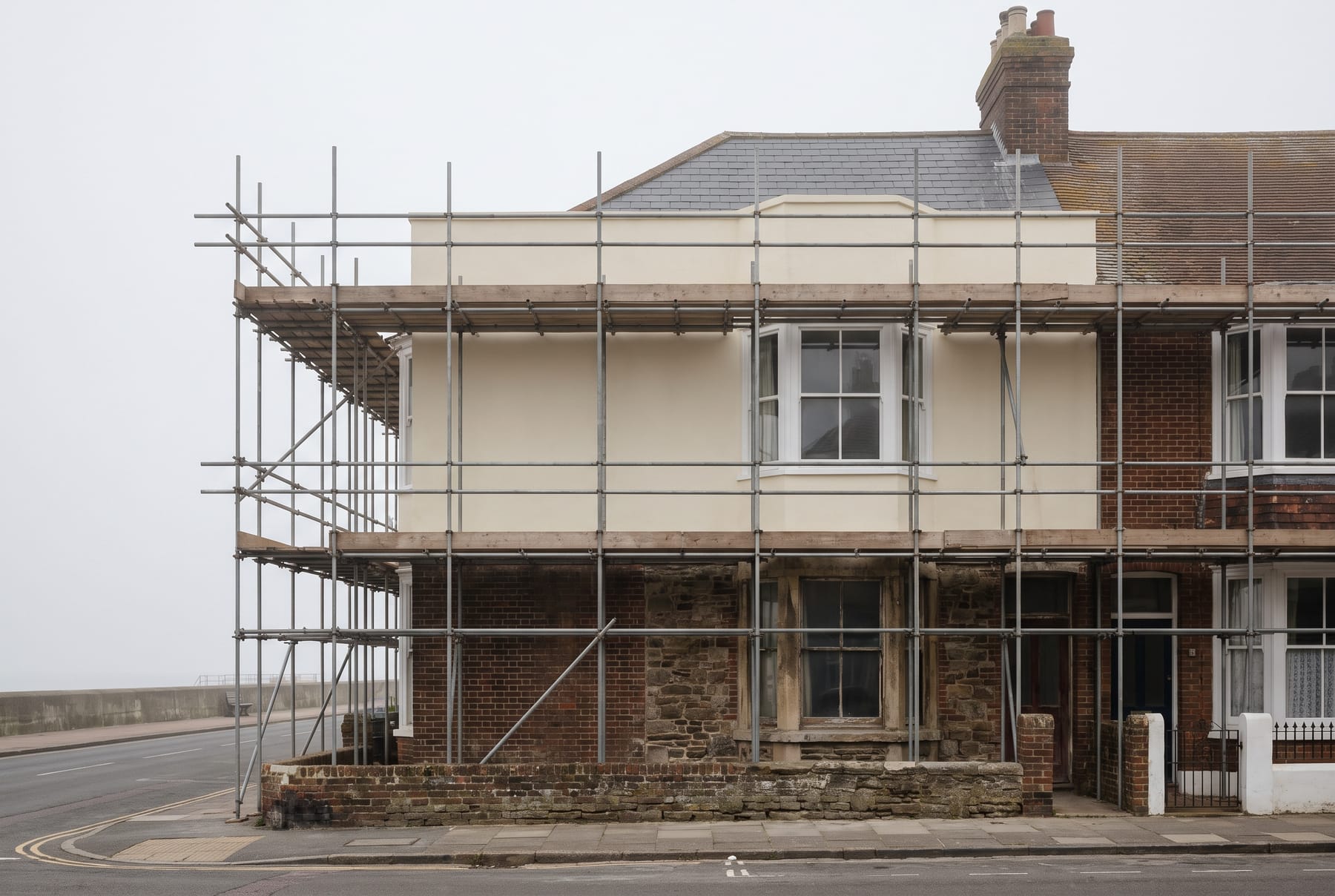
Deep retrofit of acquired residential and small-commercial stock is delivered on the practice's own balance sheet, under PAS 2035 and PAS 2038, to the standards published under Approach. Each completed scheme is a real measurement of whether the practice's specification and supervision discipline holds up in occupation.
Build the software against real schemes
Software for design generation, compliance review, cost planning and procurement is developed and refined against the practice's own live workload, rather than as a speculative product. Each tool is required to reduce the cost or improve the quality of an actually-built outcome before it is retained.
Move into infill and intensification
Once the software stack and the practice's delivery capacity are proven on retrofit, the same disciplines are applied to small-site infill, vertical extension and change-of-use intensification within the same South Coast operating area. The objective at this stage is to demonstrate density delivered at quality at small scale.
Publish the methods, not only the buildings
The practice intends to publish the technology and methods it develops, alongside the buildings themselves, in a form usable by other operators willing to work to the same standards. The national housing problem is not solved by a single practice; it is solved by the diffusion of working methods that produce better buildings at lower unit cost.
Limewise operates without external equity. The practice is the development arm of CSQS Ltd, a chartered quantity surveying firm in its sixth year, and is funded against the same balance sheet. That structure was chosen deliberately. A practice that intends to demonstrate, over a decade, that better-engineered buildings can be delivered at lower cost is not a practice that can be governed against quarterly return targets. The work requires patience, candour about underperformance, and the freedom to refuse schemes that cannot be done to standard.
The practice is small and intends to remain so. The leverage that delivers national-scale impact is not headcount; it is the technology that the practice develops and is willing to share. The work is being undertaken because the country needs it done and no incumbent operator is positioned to do it.